Wednesday, 19 October 2011

Private Practice

The Final routine for release technique. I was trying to practice when there was free studio available so I could really travel and use the whole space and explore different dynamics to travelling and also try it with different music to see if it works and if it didn't work with the opposite type of music.
Something Im looking into at the moment for a solo im currently creating is whether movement has to go with a piece of music or whether the connection between the movement and the opposition to the music is enough. We find as a society that we like things to match it satisys us. But do opposites attract?

Tuesday, 18 October 2011

'Moving to balance'

This video shows the idea of just moving through a balance rather than completely having to stop. I noticed from watching this video I need to move my top arm so I have one straight line from the tip of one hand to he other. On this clip Iplace my arm slightly behind my body which is incorrect.

Full Cunningham Class 17/10/11

This was the first time in a while that we have had Juliet for technique.It felt good to have her back as a teacher as we have had have her for two years so she knows our own strengths and weaknesses. I feel like some of my weaknesses in this class are getting better but sometimes I need a little reminder so that I remember.
    
Juliet's class is a Cunningham based class which focuses on positions of the back (my weakest area) I find that doing an 'upper curve' which just uses the upper part of the back manageable for me to do with the little range of movement I have. The curves are harder for me when it comes to the middle back but I am working on this and need to think more of pushing my belly button into my spin rather than having a deep plie. I doesn't matter if I'm not as deep everyone else in my plie just as long as the positioning is correct.
     I also need to work on my back curve, keep my ribs pulled in and not to push my hips forward and really isolate the upper back going backwards almost over the ribs, like having a corset on.


You can see on this picture that I am slightly pushing my pelvis forwards to give myself a bigger range of movement, I need to keep my pelvis tucked under and ribs quiet to be able to make the correct position.

This is a picture that I have uploaded to try and show my improvement on my middle back curve, I am starting to remember to not bend in the hips but push my belly button to the spine. I appreciate that my movement In my back is little so it will be hard to see a massive improvement.


Middle back curve in parallel, from this picture I have just noticed that I slightly roll my feet inwards I need to work on keeping every toe on the floor and have a flat foot.


When we get moving in this class I feel like one of my major strengths is that I can travel and really move when asked.  However I struggle travelling when doing triplets, they feel quite uncomfortable to do and have the 3 steps equal size, feels quite awkward, I think this would be a interesting feeling/dynamic to explore as I am used to things flowing so it would be hard to make things awkward and staccato almost.

There was one exercise where we had to balance in an open like movement but to do this we had to keep moving to balance, if I think of balancing and stop still then I will definitely wobble whereas if i think about moving through the movement I will be able to keep my centre intact and move through the balance rather than just stopping still.

We were set an adage to do that was quite challenging as it had a lot of positions and balances in. At first as soon as I saw it demonstrated I thought to myself that I wouldn't be able to do that and that I don't have the strength. Our teacher told us not to think like that and to think that if we tell ourselves that we can do it then our body will respond to this whereas if we start an exercise with a negative mind set it will come across in the movement. I tried this approach and I started to believe more in myself and that came across. I can use the same concept for adage as in the other exercise: to balance is to move.  I think this advice has a very positive outcome and is a mindset which I can and will transfer into wider life. 

When in this full Cunningham class I can definitely feel my core working especially when we are in an upper curve doing the bounces, but the idea of the bounce is not to bounce up and down but to help us get deeper and deeper into our curve. I know when doing standing practice to use my core but sometimes I forget when we start moving around the space so this is one thing I need to really work on and remember to do because this will help with travelling on the triplets which I have mentioned I struggle with.

Saturday, 15 October 2011

Graham and Cunningham 14/10/11

In today's technique lesson we did a mixture of both the Graham and Cunningham's technique. We rushed through the Graham bit on the floor so we could concentrate a bit more on the Cunningham side of things.

Personal Goals and Improvements for Graham:
  • Contractions - I feel like I have Improved on the contractions of the Graham technique, although these are not perfect yet, I am starting to understand more about where the initiation of the contraction comes from.
  • Curves - when I'm curving over from a second position I need to be able to keep my hips on the floor, if this means I cant curve over as much then I need to compensate this.
  • Awareness - Also when sat on the floor I need to make sure that I am always sat in an exact upright position and not slightly leaning forwards.
When doing this technique It feels quite un-natural to do and also it hurts my hips. I think this is because I am trying to sit upright and on top of my sits bones all the time which feels slightly uncomfortable.
     I like this technique because I can feel it working in my core.  The technique only works if you hold everything especially when pointing and flexing your feet, I have to point them to the maximum so my heels are actually off the floor. I know that every muscle in my leg is then working to the maximum.

Cunningham technique
The Cunningham technique was initiated by Merce Cunningham, he has been a driving force in modern dance and has been so for more than 50 years. Cunningham works on the basis that music and dance exist independently of each other. Cunningham also uses the idea of chance when creating dances, he wanted to challenge the way in which choreography was made. Sometimes it worked and sometimes it didn't.  This was a risk taking approach which example enables me to feel free to try things now.

For this technique you need a strong sense of the movement capability in your spine. This is one thing that i find very hard as I feel that I don't have a lot of movement in my back and spine. I am starting to be able to understand this more and be able to adapt e.g. in a middle back curve, I need to not plie as much from the hips and initiate the curve from my core.

Choreography:

Its interesting to look at Cunninghams work for choreography ideas; the idea that music and dance don't need to fit together. In some cases Cunningham didn't bring the music and the choreography together until the dress rehearsal where he would find out if worked or if it didn't. In human minds we 'like' things to fit together but I find that in some strange way there is a sense of comforting when things don't fit together, it makes you look at things in a different light.
I would love to be able to choreograph in ways that Cunningham did, using chance etc.It would take a lot of courage to be able to do this as it would be a very different style to what I am used to but it would be interesting to experiment with this.

Tuesday, 11 October 2011

Ballet 11/10/2011

In this weeks class we covered a number of different steps, a lot of corrections were given. The main point that was emphasised throughout the class was about turn-out and always being able to "use" your turn-out and increase it to your maximum capability. I noticed that in ballet everything is connected, if you let your arm fall out of second then you forget about you feet whereas if you link arms, head and feet together then it makes it a lot easier and gives a nice flow.
The foundation of Ballet technique is all about "pulling up" this a term used to describe the posture, turn out and alignment.  For my correct alignment I need to scoop my core and be "on" my legs and also to tuck my tail bone under. I find that I am slowly remembering to do all this but only when I think about it. I need to be able to do it with out thinking about it and so it comes naturally to me, lock it into my muscle memory.


This is a position where we have to be able to balance, I feel like I have improved slightly since the beginning of the semester but to enable me to hold this I need to; pull up on my supporting side and on my supporting leg, scoop the core and be on full releve. This will get better through time, I will upload a video shortly to show improvement. 


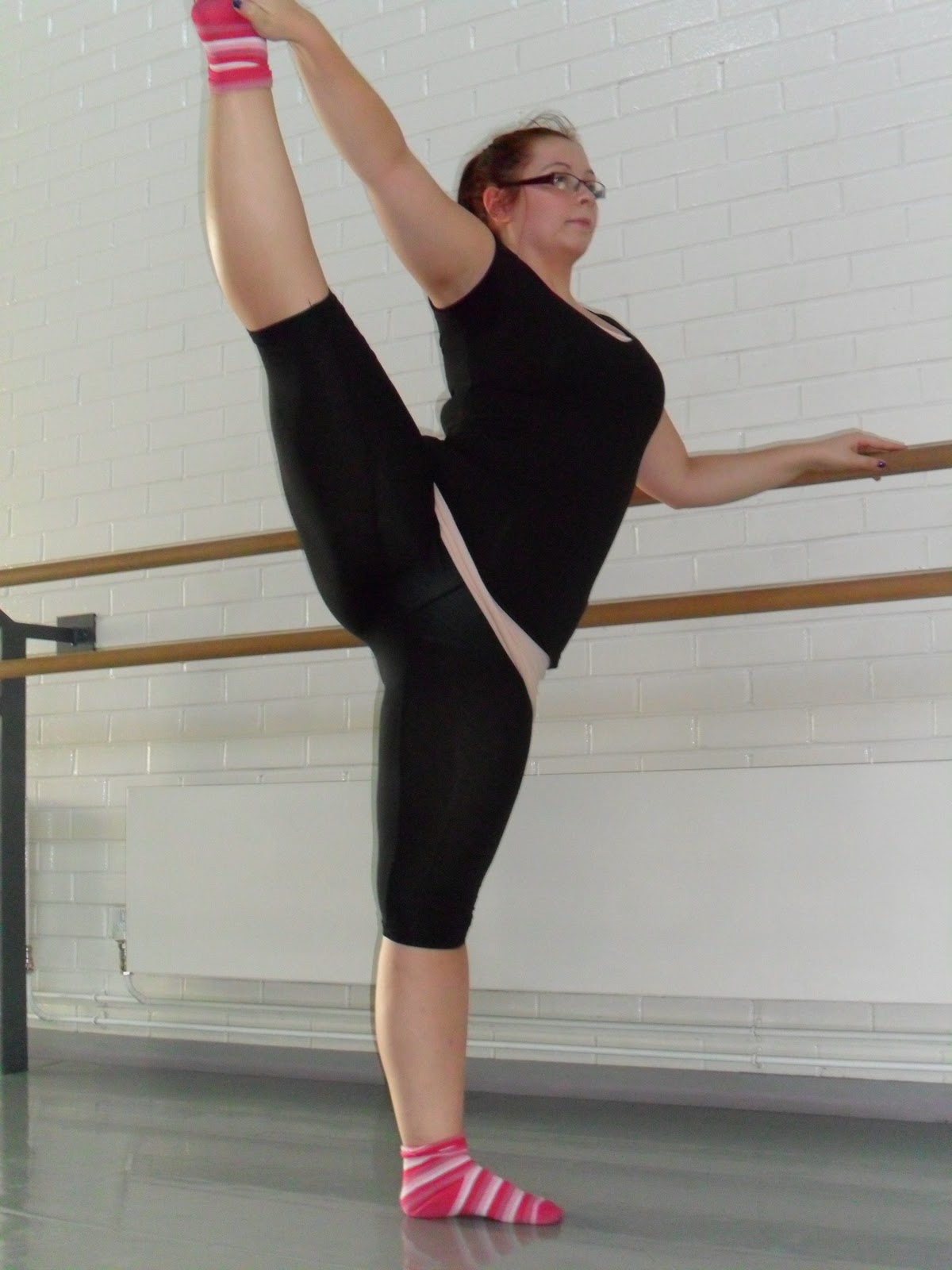
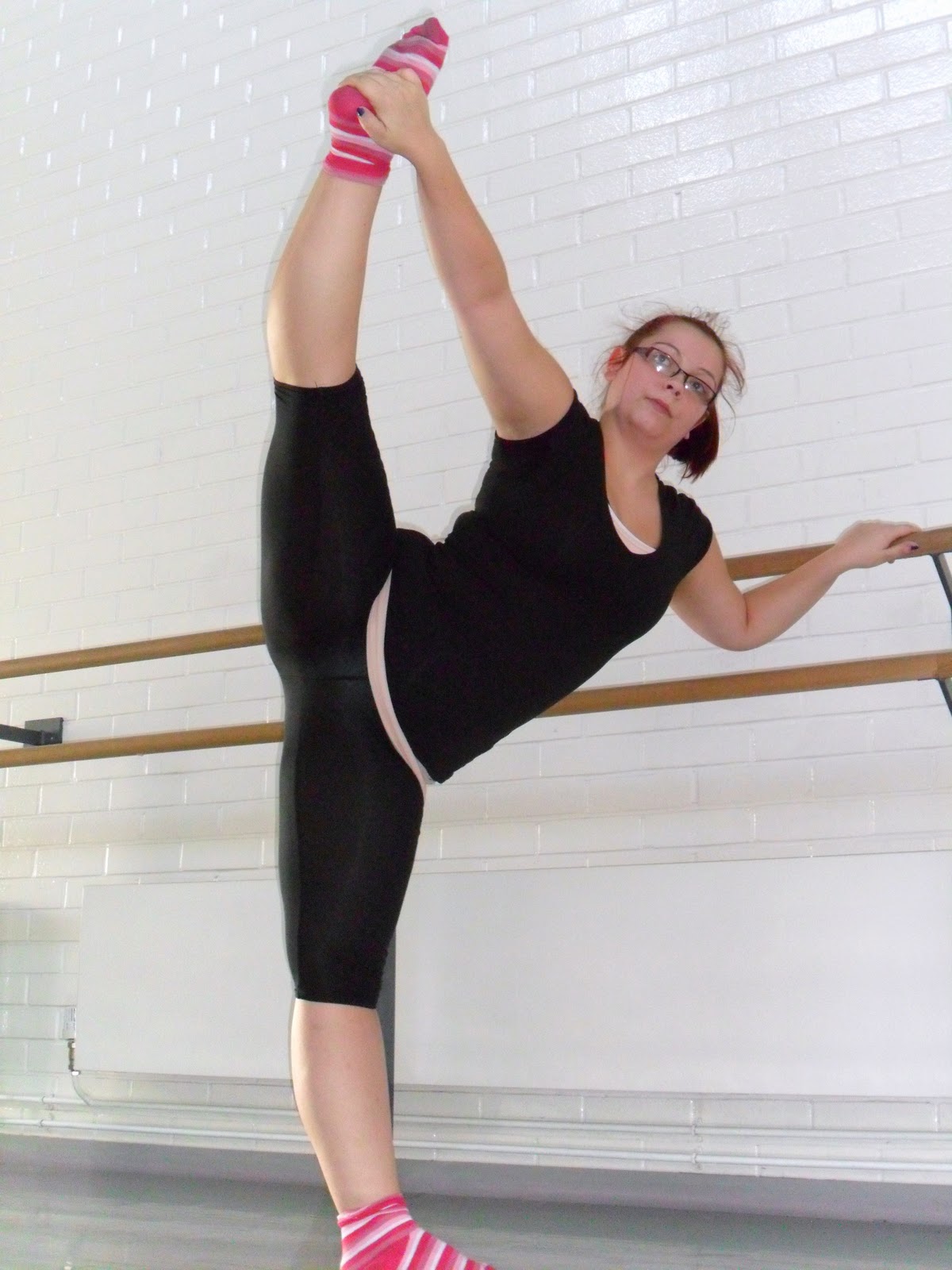
These are a couple of the stretches that we do in class to improve are flexibility. This will also help the strength when it comes to devlopes and grand battements. I can already see An improvement with grand battments now I have to focus on My devlopes and not holding it from my quadriceps but form underneath my leg.

The aim for this stretch is to make me more flexible and give me more strength. I want to be able to hold this without holding the bar and pull my leg closer into me.


Personal Goals
  • To be more flexible in my legs, this will come from doing the stretches in the above picture everyday
  • To be able to throw my legs up in battements and control it down. Using underneath the leg instead of the hip or the quadriceps
  • Go through my feet more, more definition in tondus.

Sunday, 9 October 2011

Graham Technique 7/10/11

This is the first time that I have properly studied the Graham technique, although I have done a little bits in GCSE and Btec dance we never really covered the technique in great depths.
The Graham Technique was created by Martha Graham.Graham was an American dancer and choreographer who's influence on dance has been compared to the likes of Picasso and the influence he had on visual arts and Stravinsky's influence on music. Graham broke the rules and the mold of classical ballet and pioneered the first move into modern dance. The fundamental principles in the Graham technique are; contraction, release, weight shift and spirals. The idea of "contraction and release" gave Grahams dancers a look that had never been seen before, the movement gave the dancers a hard, angular look that was different to anything anyone had ever seen, different form the work made by: Ruth st Denis and Isadora |Duncan as this was always very soft and a lyrical way of dancing. Grahams work was often described as 'ugly'.
“Martha and other early modern dancers were experimenting to find individual ways of creating art,” Dakin says. “Be daring every time you move. You’re not there to reproduce what someone else did. Individual exploration is inherent to class and Martha’s movement.” J.Legg November 1st 2006 accessed on: http://www.dancespirit.com/articles/10
It seems apparent in the class that you have to be able to take risks throughout, don't play safe. The technique needs volume and energy, Use your breath to get deeper contractions by breathing out and sending the breath there your making it easier for yourself, By holding the breath your fighting against the natural body movement.

Personal Goals:
  • Breath into the movements and the contractions, don't fight against it
  • Over time I need to work on deepening my contractions and getting a bigger range of movement, this will only come over time and with practice, not just a class once a week
  • Trying to create a bigger curve in my back when doing centre work.
How it felt:
At fist it felt strange as there is a lot on going on at one time, a lot of different arms with the body movements and it was a lot to take in on the first class. Although I have done contractions before, the Graham technique demands for deeper contractions "true contractions" it needs a sense of ripple in the body, beginning from the pelvis and up the spine and this is the same for the release, release from the spine upwards and not all in one go. The exercises were very specific to the counts of the music, and also quite  fast paced, it really got me thinking and my brain working as there is so much going on.

coming soon: video's and pictures of movements I need to improve and exercise in the class

Picture of a Graham contraction, this needs a lot of improvement, I don't feel like I have a lot of  movement in my back but with practice and stretching to make my back more flexible I feel like the contraction could become more visible.

Below, a Graham contraction from different angles


Exercise on a 6- different points of the exercise


I need to use my core from this position into the next position to push my hips forward I also need to remember to keep my ribs held and not let them relax.

Wednesday, 5 October 2011

Bartenieff Fundamentals 5/10/2011

In this contemporary technique lesson we are studying and looking into more detail the Bartenieff Fundamentals.  This idea came from Laban movement analysis. Peggy Hackney wrote a book about these fundamentals called "making connections". It focuses on basic movements: breath, core support, alignment, rotation, phrasing and spatial intent.

This week we focused on core alignment, working from limbs of our body: 2 legs, 2 arms, head and pelvis. We looked into how we can reach these 6 points, reaching to the limits of our body and also having the sense of pulling our bodies into shapes eg pulling everything in to a ball shape or expanding everything into an X-shape. We then went onto an improvisation that allowed us to be more free in the movement but always thinking of core support and the 6 limbs.

Personal goals:
  • Improvisation and relaxationg - To relax into this movement and try not to think about what I am doing. Let the improvisation be a true improvisation
  • Exporation and freedom - Explore the movement more and try not to stick to what I normally do.
  • Risk taking - Push myself to take risks
Feelings that occurred:
      When exploring this movement, a feeling of expansion occurred.  I realise that when I dance I don't normally use the full width and height of the expansion that I have within my range of movement. It was a nice feeling to bring everything into a ball and then stretch right out. I found it difficult to keep thinking about the fundamentals when I danced because I just seem to get carried away with the music and the movement, but when I slow down and think it gives me a chance to apply these fundamentals and I notice a change straight away.
      The Fundamentals are a useful tool for choreographing.  Their use allows a different dynamic  and I will come back to these ideas when choreographing and ask my dancer to think about them and see if this brings out anything more in movement.

Applying this to dance:
        When applying this to combinations, I started off just dancing as I would normally but when I was reminded of my 6 limbs it gave the movement a completely different quality and when also applying breath it has a dynamic quality. When observing other peers in my class I can really tell the difference when they apply the Bartenieff Fundamentals. They look strong in their core but relaxed in their limbs it gives their movement a lovely quality that I could watch for hours.

      In our technique class on the 28/09/2011  we were looking at using the breath, this also reflects into the other techniques that we have been studying, release technique and Limon technique. To hold your breath when dancing shows tension in different parts of your body whereas to breathe into the movement gives you a bigger range and also more flexibility. This is a more relaxed way of dancing and keeps me calm under pressure.